Loading…
Finance and Audit Suite
Finance and audit tools built for engagements, reconciliation, testing, and serious analytical review.
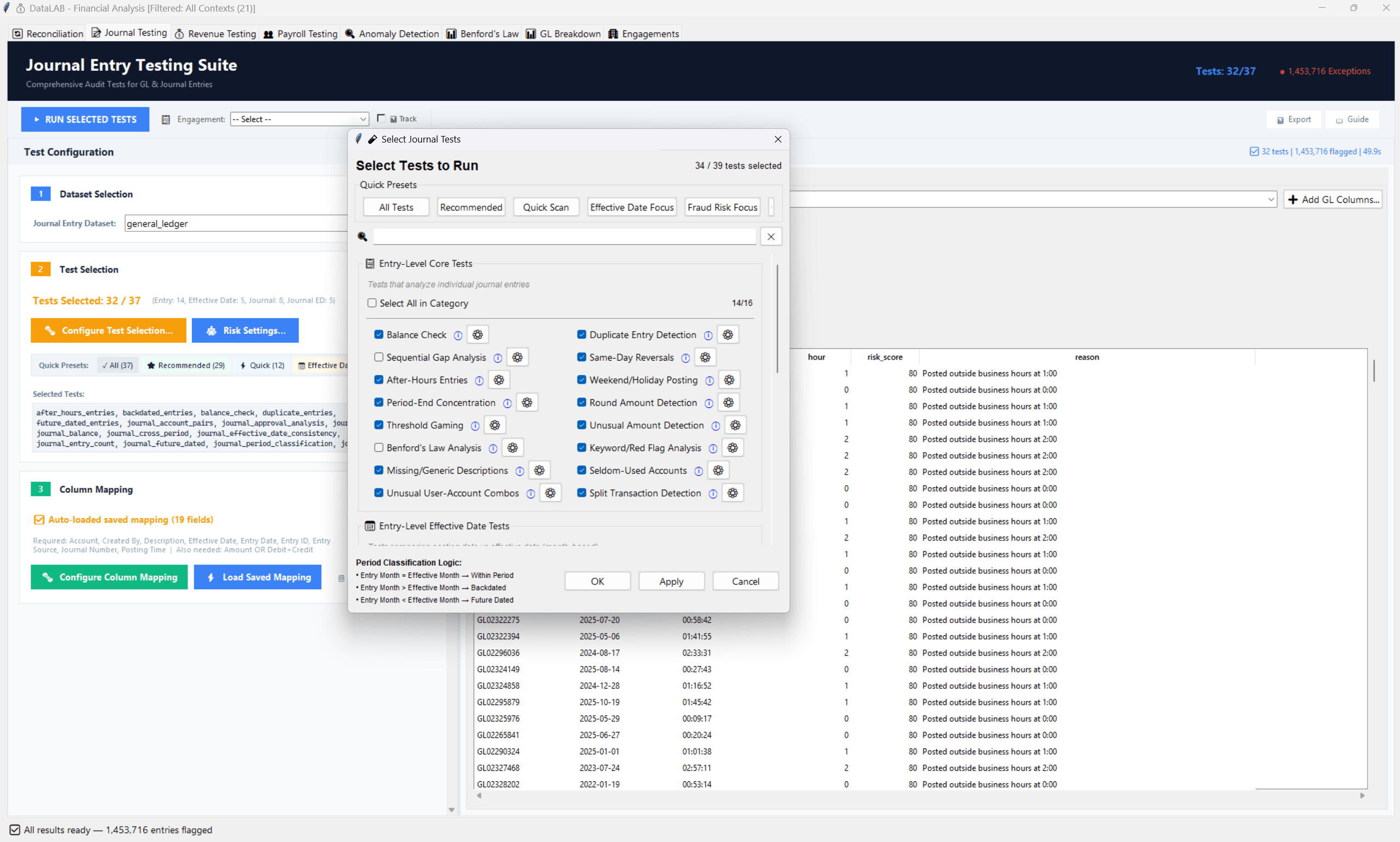
This is the sharpest current wedge for Snaplytics. DataLAB already has meaningful depth across journal testing, revenue testing, payroll testing, reconciliation, engagement management, validation, and anomaly-oriented review.
The product is desktop-first today. A web experience exists as an early MVP, but the strongest client-facing finance and audit workflows are still led through the desktop product and pilot engagements.
Finance and audit suiteEngagement-led testing and exception review
Finance teams closing under pressure
The strongest fit is where month-end, balance review, and exception handling still depend on too many spreadsheets and fragmented checks.
Audit and engagement-led client work
The product becomes more compelling when finance or audit teams need to structure work by engagement, period, dataset assignment, review state, and repeatable procedure.
Desktop-first operations
Today the suite is led by the desktop product. The web experience exists as an MVP, but it is not yet the main production surface for clients.
Suite Coverage
What teams can already do
These are not abstract roadmap ideas. They are the categories of finance-heavy and audit-oriented work that already make the platform commercially interesting.
Journal testing
Run large test packs against journals and review flagged entries, risk signals, and exceptions in one working surface.
Revenue testing
Evaluate revenue recognition, cut-off behaviour, spikes, credit memo patterns, and other revenue-heavy control questions.
Payroll testing
Investigate payroll exceptions, duplicate behaviour, unusual movements, and testing scenarios that need repeatable rule-based review.
Reconciliation workbench
Work through two-way and multi-way reconciliations with configurable tolerance handling and exception review support.
Engagement management
Set up engagements, track entities and periods, assign datasets, and keep testing and review work scoped to the right client context.
Audit-ready review support
Use validation, traceability, and structured exception review to support recurring analytical review procedures with stronger consistency.
Why It Matters
Finance and audit review should not live in disconnected spreadsheets
Teams lose time when engagement setup, reconciliation, exception testing, validation, close support, and analytical review are split across too many ad hoc files. That makes the work slower to repeat, harder to explain, and easier to break under pressure.
DataLAB is compelling here because it puts structured finance and audit review tools next to broader analytics capability. Teams do not have to choose between spreadsheet-led review and a generic analytics stack that ignores suite-specific workflows.
1
Set up the engagement
Define the engagement, assign datasets to the right entities and periods, and create a cleaner starting point for financial and audit review work.
2
Run tests and investigate exceptions
Move from test selection to flagged-entry review, reconciliation, anomaly investigation, and validation without rebuilding every analysis in ad hoc spreadsheets.
3
Export, explain, and hand off
Push results into close support, audit review, partner discussions, or recurring reporting with a more repeatable analytical trail.
finance_audit_suite.sql
-- Engagement-scoped financial and audit review
PIPELINE monthly_finance_review(@period DEFAULT '2026-03'):
    LOAD "general_ledger.csv" AS gl WITH detect_types=true
    LOAD "bank_statement.csv" AS bank WITH detect_types=true

    WITH gl_period AS
        SELECT *
        FROM gl
        WHERE period = @period

    VALIDATE gl_period WHERE amount > 0 AND account_id IS NOT NULL

    RECONCILE gl_period TO bank
        ON account_id = account_id
        COMPARE amount
        TOLERANCE 0.01

    EXPORT discrepancies TO BROWSER AS monthly_review_discrepancies
END PIPELINE;
Commercial Wedge
This is the clearest early story for Snaplytics
The combined finance and audit suite gives the product a sharper point of view than a generic analytics message alone.
Better than generic positioning
A finance and audit suite is easier to explain than a broad all-in-one analytics message because the pain is obvious and the workflow value is concrete.
Closer to buyer pain
Reconciliation, engagement setup, journal analysis, validation, and exception review map naturally to month-end pressure, control work, and audit readiness discussions.
Strong desktop-led fit today
The current maturity of the suite matches the desktop product well, which lets Snaplytics sell the wedge honestly while the web MVP continues to evolve.
Want to see the finance and audit suite in context?
The best next step is a focused demo around engagements, reconciliation, testing, validation, exception review, or the specific client workflow your team wants to tighten up.